Who wins the 2026 World Cup?
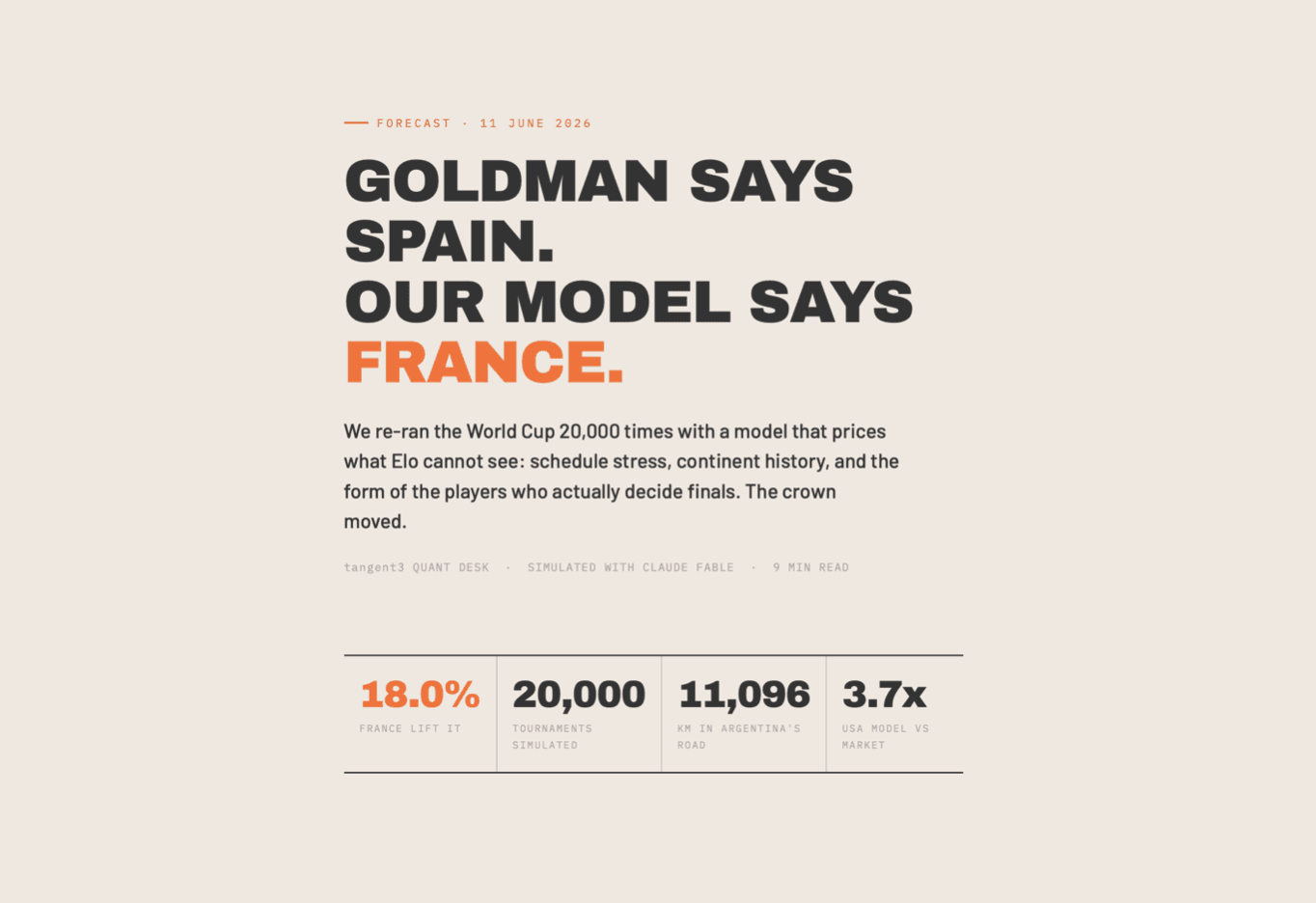
We re-ran the 2026 World Cup 20,000 times with a model that prices what Elo cannot see: schedule stress, continent history, and the form of the players who actually decide finals. The crown moved.
Our quants spent the final week before kickoff locked in a room with Fable, Anthropic's frontier model, feeding it everything the tournament has produced so far: the confirmed FIFA schedule, venue by venue, the June friendly results, the injury bulletins out of Spain's camp in Chattanooga, ten years of wet-bulb temperature data for sixteen stadiums, and the flight paths between all of them. Then we made it play the World Cup. Twenty thousand times.
The headline surprised us, because our first pass agreed with everyone else. Run a conventional ratings model and Spain win this tournament. Goldman Sachs got 26 percent. Our Elo-weighted baseline got 24. Same model family, same answer, and in our view the same blind spots. So we rebuilt the inputs, and the trophy changed hands.
France, and it is not close to a coin flip
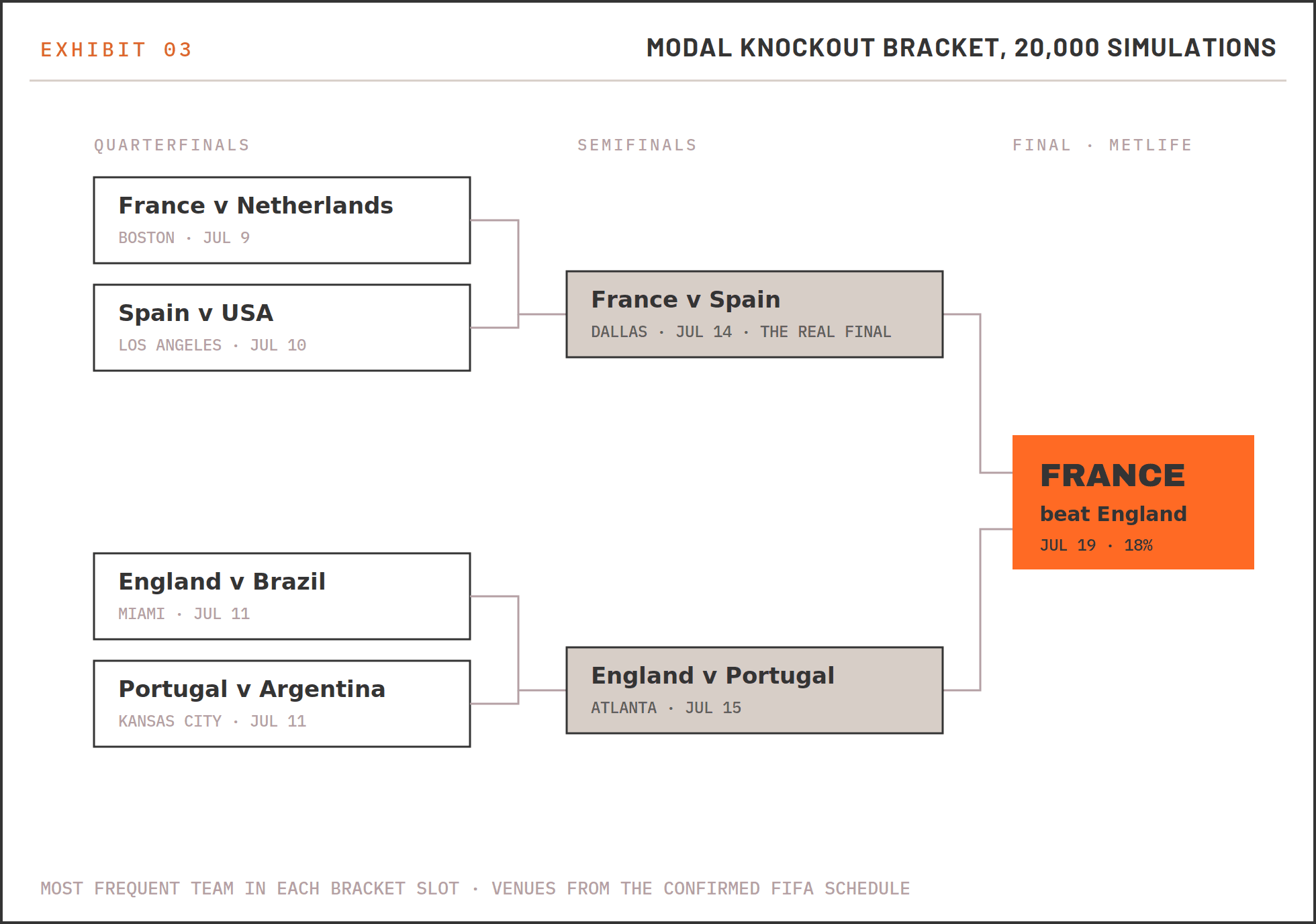
France win the 2026 World Cup in 18 percent of our simulations, clear of Spain at 12.9, England at 10.6 and Portugal at 10. The modal final is France against England at MetLife on 19 July, with the tournament's real heavyweight fight happening five days earlier: France against Spain in the Dallas semifinal.
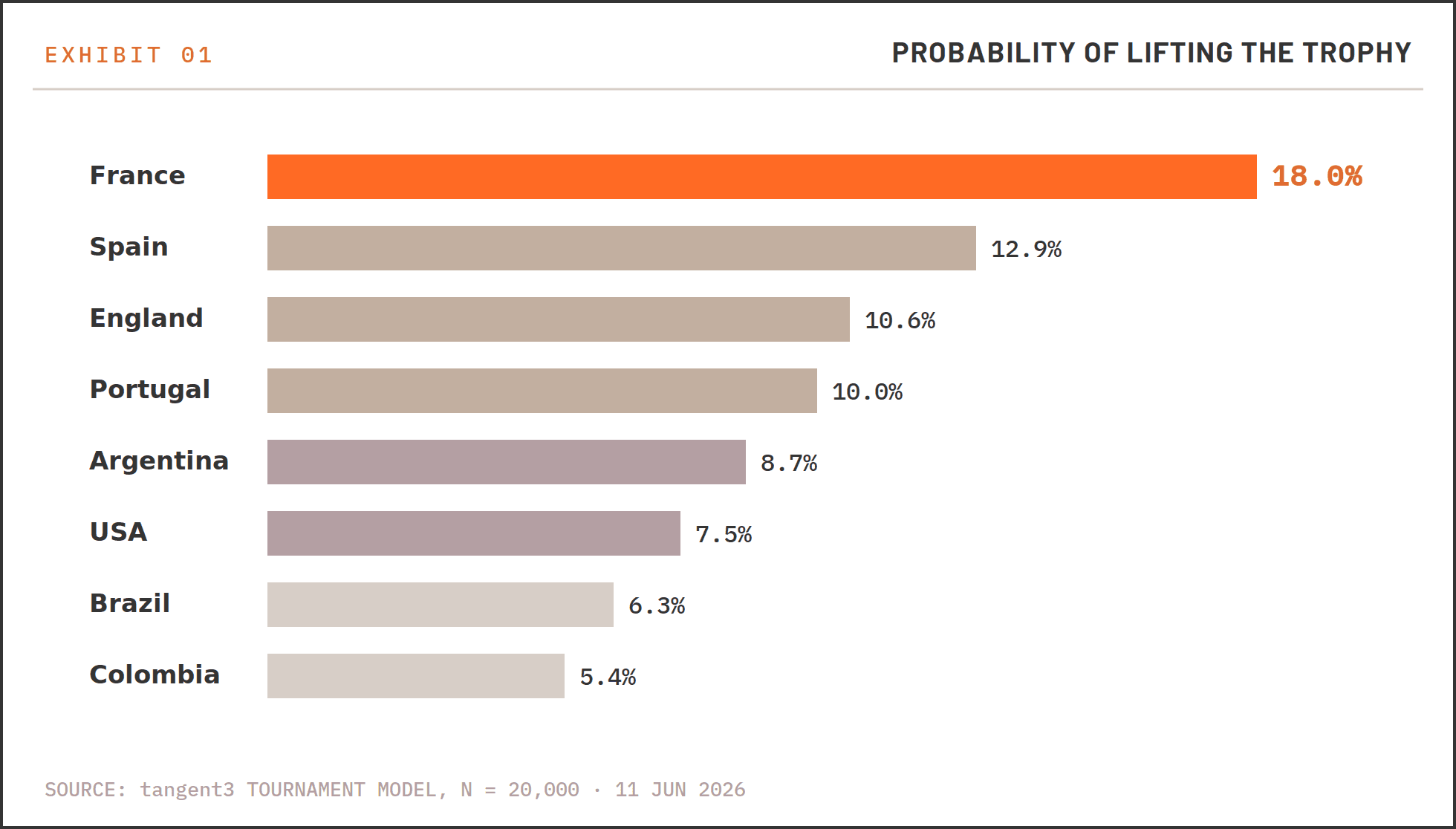
Why France? Because they are the only elite side that wins on every layer of the model at once. The squad arrives in the best attacking form in world football: Ousmane Dembele lands as the reigning Ballon d'Or holder, Michael Olise has been the most productive wide player in Europe over the spring, and Kylian Mbappe is Kylian Mbappe. The market wobbled when France lost a June friendly to Ivory Coast. We treated that as noise against a season of signal.
Then there is the part nobody prices. France play their entire group within a 546 kilometre triangle in the Northeast corridor, the second shortest itinerary in the field. Win Group I and the knockout legs read 274, 138 and 409 kilometres before the semifinal. While rivals criss-cross a continent, France effectively play a home-county tournament until the final week. Schedule is destiny in a 39-day, three-country World Cup, and France drew the kindest one of any contender.
Four layers, one unconventional model
Most forecasts stop at layer one. The interesting answers live in layers two through four.
Layer 01, conventional power. Elo-style ratings calibrated against betting markets and ten years of international results. Necessary, nowhere near sufficient. This layer alone crowns Spain, exactly as Goldman's does.
Layer 02, stress: heat and travel. Great-circle distance across each team's confirmed venues, plus peak wet-bulb globe temperature per stadium, the FIFPRO standard. Standardised, age-weighted, and recomputed live through every knockout draw.
Layer 03, continent bias. European teams have won in the Americas once in nine attempts. We apply a measured headwind to UEFA sides and a tailwind to CONMEBOL and the hosts, not a curse. Germany 2014 proved curses break.
Layer 04, performance bias. Ninety-day player form and injury reality. Yamal's hamstring restricts Spain through the group phase. Dembele and Olise arrive peaking. Iran's relocated camp gets priced. Elo sees none of this.
Layer two deserves its own chart, because it is where this tournament will quietly be decided. Heat and travel are different problems, they barely correlate across the 48 teams, and almost nobody is carrying both. Three teams are.
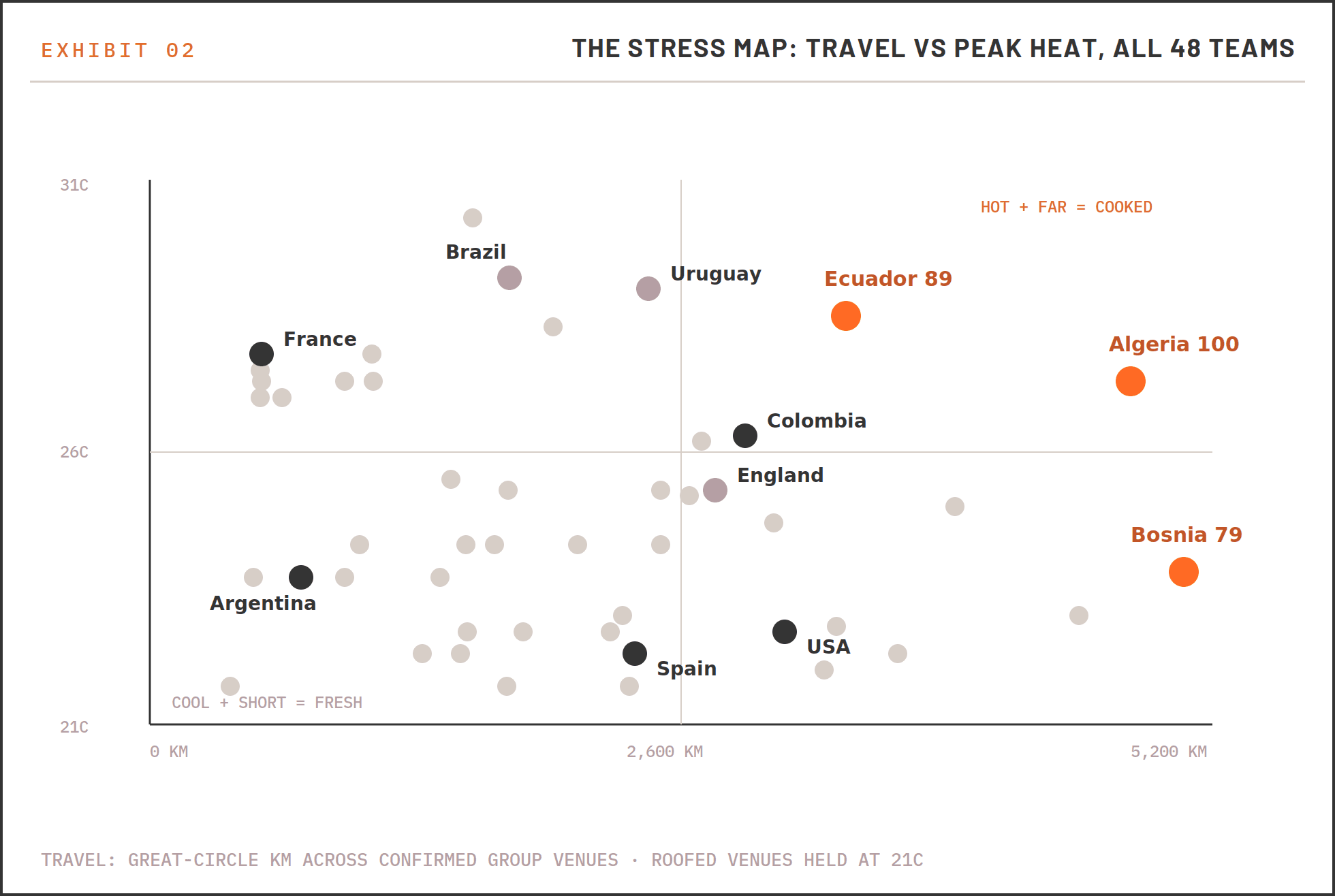
Notice where the giants sit. Spain drew the coolest schedule in the field, two matches under the Atlanta roof. Argentina drew the softest group itinerary of all 48 teams. But here is the model's favourite discovery, and you will not find it in any preview: the stress index inverts in the knockouts. We recompute it for every simulated draw, leg by leg, and Argentina's most likely road to the final runs 11,096 kilometres, including a 4,491 kilometre haul from Miami to Vancouver, carried by the oldest squad among the contenders. France's road before the semifinal: 821 kilometres. The defending champions trade the tournament's easiest group schedule for its hardest knockout geography, and it costs them roughly a full seed line.
Our quarterfinal eight
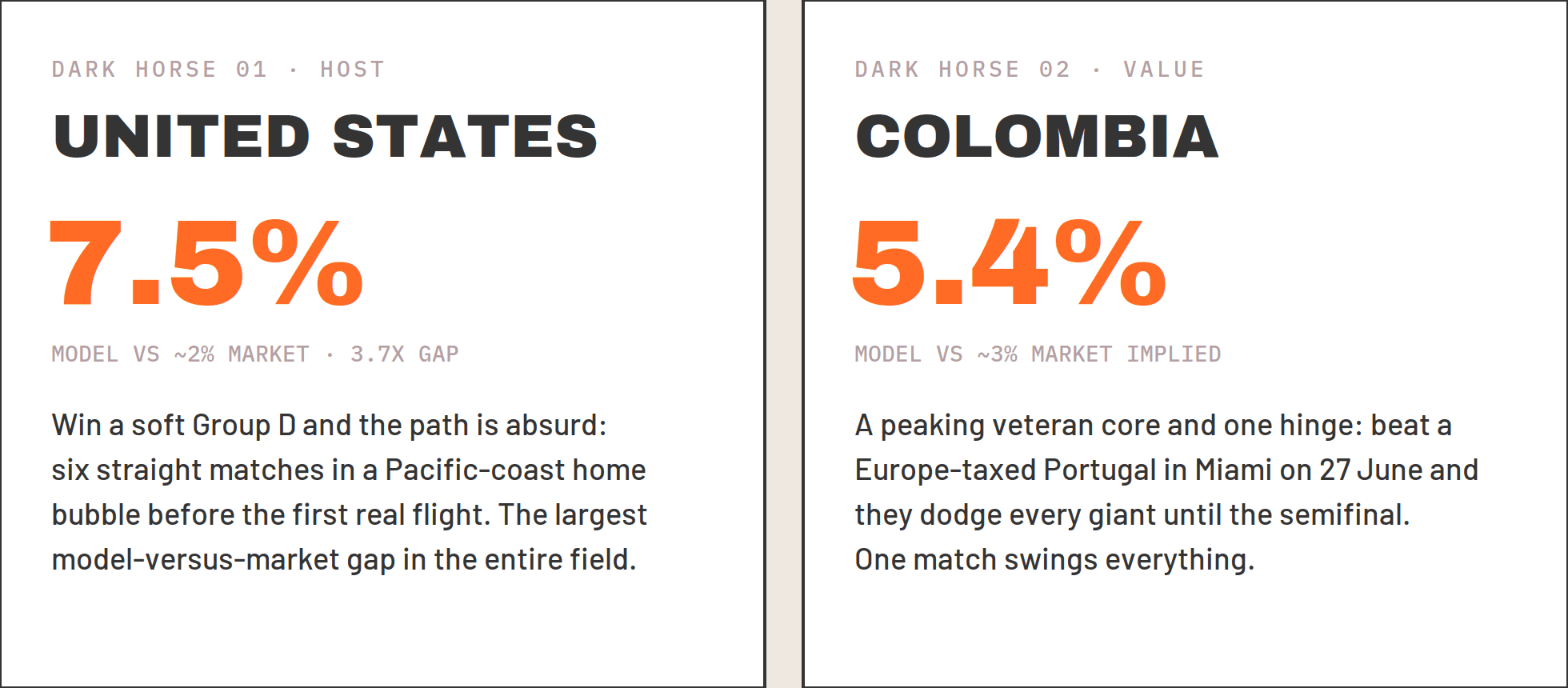
France, Spain, England, Portugal, Argentina, Brazil, the United States and Netherlands. Six of eight chalk, two stories worth telling now: the USA reach this round in just over half of all simulations, and Colombia miss the cut here only because the Portugal collision arrives one round too early.
Two dark horses the market is napping on
About that Goldman call
Goldman Sachs published its tournament note in late May: Spain 26 percent, France 19, Argentina 14. It is a serious piece of work built on a serious foundation, Elo ratings fed by nearly 20,000 internationals since 1978. We know, because when we weight our model the same way we land within two points of their answer.
The divergence is not the maths. It is the inputs. An Elo model carries Spain's rating into July with Lamine Yamal at full power, even though he has not played a competitive minute since April and his own club has asked Spain to ration him through the group stage. It books France's friendly stumble against Ivory Coast as a real downgrade, rather than noise around the most in-form front line in the sport. It does not know that Atlanta has a roof, that Kansas City in July does not, or that Argentina's most probable knockout road crosses four time zones twice. We did not build a different model so much as we asked the same model better questions.
Worth remembering: the gold standard has been beaten by the tournament before. Goldman gave Brazil 18 percent in 2018 and watched them exit in the quarterfinals while the trophy went to a team they ranked second. Which, as it happens, was France.
Twenty thousand tournaments, one conclusion. The schedule is an opponent, form is a fact, and history votes. France clear every layer. Spain clear one.
We will re-run the full simulation after every matchday. If Yamal starts against Uruguay and looks like himself, the gap narrows. If Argentina top Group J and inherit that Vancouver flight, it widens. That is the point of a living model: it argues with the tournament in real time.
Enjoy the football. We certainly intend to.
——
METHODOLOGY FOOTNOTE: 20,000 Monte Carlo simulations of all 104 matches under full FIFA 2026 rules: 12 groups, official tiebreakers, eight best third-placed teams slotted by the published bracket constraints, extra time and penalties in the knockouts. Team strength blends market-calibrated power ratings (de-weighted 22 percent), 90-day form and injury adjustments, a confederation factor, and a schedule-stress index built from great-circle travel between confirmed venues and ten-year peak wet-bulb globe temperature per stadium, age-weighted and recomputed at every knockout leg. Simulated with Claude Fable. Probabilities are model estimates, not investment advice, and certainly not an excuse if Didier Deschamps parks the bus.
© tangent3, June 2026.