Stop Asking How Much You're Spending on AI
Too many companies are treating AI tokens like a cost problem instead of a value-capture opportunity. This article argues that CEOs should separate employee productivity tools from product workloads, fund AI like an R&D portfolio, and use engineering not bureaucracy to control spend. The real risk in 2026 is not overspending on AI. It is restricting access so heavily that competitors learn, build, and compound faster while your organization mistakes caution for discipline.
Too many leadership teams are framing AI tokens as a cost optimization problem. It is actually a value capture problem with a cost component attached. That single reframe changes everything about how a CEO should think about AI spend in 2026.
In recent conversations with companies we advise, in boardrooms and over coffee, the most heated topic has shifted. It is no longer model capability, security, or talent. It is token costs. Every executive is wrestling with the same question: how do you build a predictable AI spend model when the underlying technology shifts every 90 days?
The strategies in the market are all over the map. Some cap spend by team. Others gate access by user tier. A few require employees to write business cases for AI use. One CIO told me last week they just opened the floodgates and hoped for the best. Nobody felt confident they had the right answer.
Here's the framework I would give a CEO this week.
Three Things Are True
Token prices keep falling fast. Frontier model pricing has dropped roughly 10x per unit of capability the last 12 months. Employee productivity gains from AI access are large and measurable. And the competitive risk of under-investing dwarfs the cost risk for almost every large company today.
Goldman Sachs estimates AI could lift global productivity by 1.5% annually for a decade. Anthropic, OpenAI, and Google keep cutting prices on their cheaper tiers every quarter.
The dominant failure mode is not overspending. It is building so much friction around AI that the organization underuses it while competitors do not.
Start With Posture, Not Policy
Before any cost mechanics, the CEO has to make one call:
Leader, fast follower, or laggard?
This single decision sets your cost tolerance, your pace, and your appetite for waste.
JPMorgan picked leader on internal tools and fast follower on customer-facing products. Grab is pushing leader across its Southeast Asia super-app, retraining engineers around agent workflows. Most companies should pick fast follower. A handful should lead.
Without an explicit call, the company will oscillate based on whichever anecdote the CFO heard at the last industry event.
Two Budgets, Not One
The biggest analytical error I see is treating these as one line item.
Employee productivity AI (knowledge workers using Claude or ChatGPT for daily work) should be default-on for everyone. Treat it like email or Slack. The all-in cost runs $20 to $50 per employee per month at enterprise scale, often less with volume commitments. The productivity gain on even one task per week pays for it ten times over.
Product and agent workloads (AI embedded in customer products or internal agents) need real engineering discipline. Model routing, caching, evals, prompt optimization. This is where token economics actually matter.
Conflating the two leads to either cost theater on employees or expensive surprises in production. Pick a different operating model for each.
Portfolio, Not Permission
The instinct to make every team justify each use case creates bureaucracy that kills the experimentation you most need right now.
Better approach: treat AI spend like an R&D portfolio with three tiers. Production gets cost-justified, ROI tracked, real accountability. Scaling covers promising work, monitored, given runway. Exploration gets protected budget, loose accountability, and permission to fail.
The mistake is forcing exploration work through production gates. Do that and you only ever discover what you already knew.
Engineering Beats Policy
The companies winning right now are not winning on policy. They are winning on engineering.
Specifically: routing layers that send simple tasks to cheap models and hard tasks to frontier models, caching layers that cut redundant calls by 30 to 70%, real-time spend dashboards by team and product, and standardized evals so you know when a cheaper model is good enough.
A well-built routing and caching layer typically saves more money than any access policy ever will. Most companies are 12 to 18 months behind where they should be on this.
Five Patterns To Avoid
The five worst patterns I keep seeing:
Hard spend caps by team. Produces hoarding at the start of the quarter and panic spending at the end. Same dysfunction as old-school IT budgets.
Access tiers by job title. Senior people often use AI less than analysts. You are pricing a bad proxy and demoralizing your best users.
Per-query business case justifications. Kills the experimentation that creates outsized outcomes.
Open access with zero observability. Eventually produces a blow-up that triggers a regrettable overcorrection.
Single-vendor lock-in on multi-year terms. The model leaderboard shifts every quarter. Optionality is worth real money.
If your company is doing two or more of these, you have a strategy problem, not a cost problem.
Renegotiate Now
Most companies are buying AI on standard SaaS terms. That is wrong.
Push for committed-use discounts because you will spend more than you think. Push for multi-model flexibility because the best model in 2027 may not be the best one in 2026. Push for data residency and IP terms that match your actual risk profile. Push for the right to substitute model versions as they improve.
I have seen companies cut 30 to 50% off AI commitments just by treating procurement like cloud procurement instead of software procurement.
The Bottom Line For CEOs
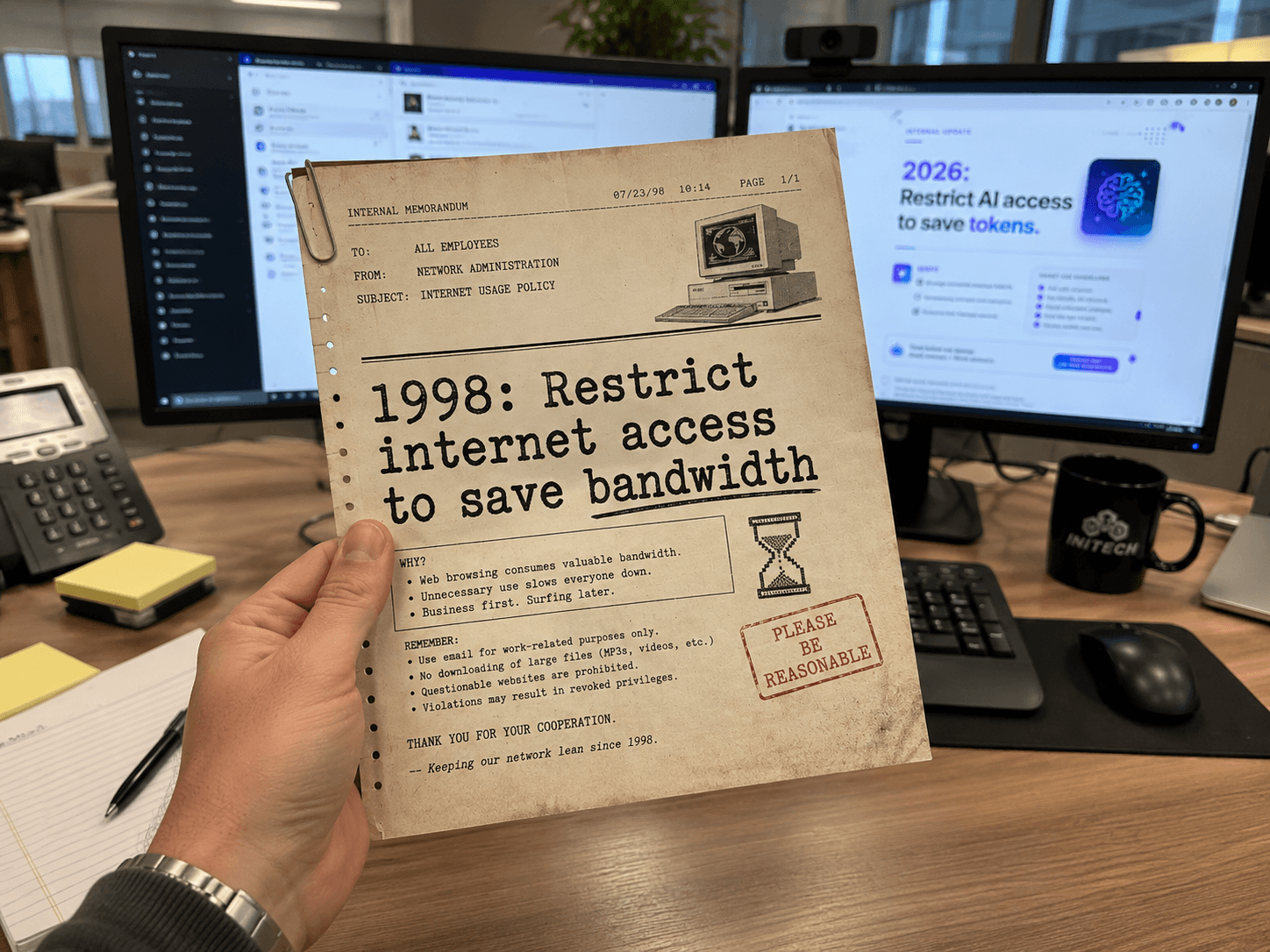
In 24 months, the CIOs who restricted access most aggressively will look like the executives who blocked employee internet access in 1998 to save on bandwidth. The downside of over-restriction is invisible. Nobody can measure what didn't get built, what hire didn't happen, what competitor pulled ahead. It never shows up in any report.
The CFO and CIO will instinctively overweight the visible cost line because that is the only line they can see. The CEO's job is to actively counterweight that bias. Nobody else in the company has the incentive or the visibility.
Too many leaders today are trying to solve a cost optimization problem. The ones who will win are solving a value capture problem with a cost component attached.
One question to sit with: in the most optimistic future for your company, will the bottleneck have been how much you spent on AI, or how little?