The AI Glass Isn't Half Full or Half Empty. It's Being Replaced by a Completely Different Container.
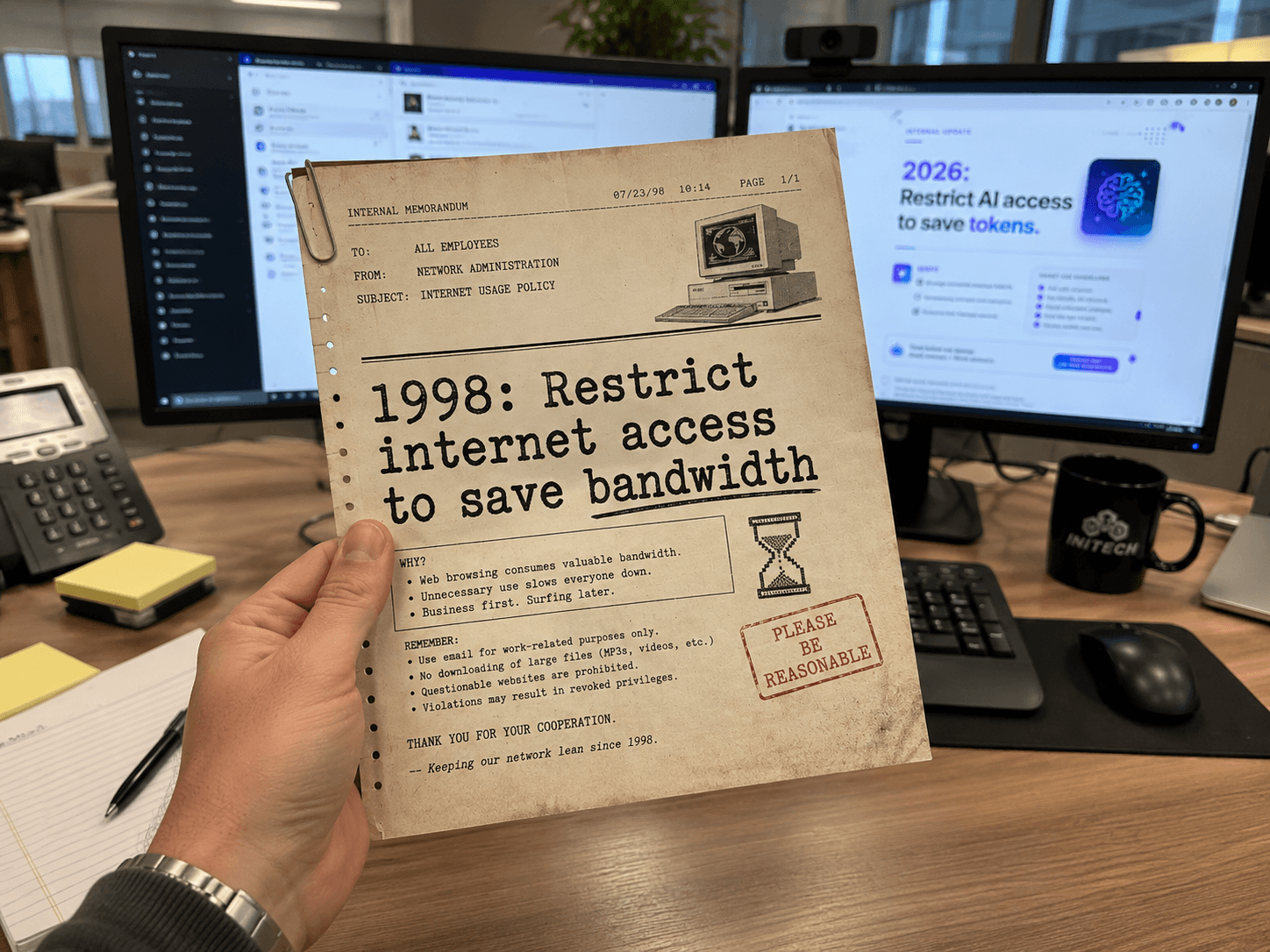
AI Will Replace Your Job and Create Your Next One. This article explains how artificial intelligence is driving the cost of intelligence to near zero, effectively destroying intermediary business models across sectors like insurance, law, and real estate. The author warns of a hidden "daisy chain" of global financial risk, where white-collar jobs, private credit, and expensive housing markets are heavily exposed to software disruption. While AI threatens to create "Ghost GDP" that sidelines workers, it simultaneously offers "Abundance GDP" by drastically reducing living and business costs. To survive this rapid transition, the piece provides a six-step playbook, urging readers to pivot from executing raw output to applying unique human taste and judgment. Instead of merely predicting the future, professionals must actively build adaptable systems. Today is the earliest you can start.
Last week, an AI agent renegotiated my insurance. Not "helped me compare quotes." It contacted multiple providers, parsed every clause, identified coverage gaps the broker never mentioned, and locked in a rate 31% lower than my renewal. The broker's entire value proposition, destroyed in 14 minutes.
That broker earns six figures navigating complexity I find tedious. The agent finds nothing tedious.
This is not a story about insurance. This is a story about what happens when the cost of intelligence collapses to near zero, and why the scariest part isn't the doom scenario or the boom scenario. It's that both use the exact same starting facts, and the ending you get depends almost entirely on what you do in the next 24 months.
The Extinction Nobody's Talking About
Forget the "AI takes your job" debate for a second. That's a distraction. The real earthquake is quieter and already underway.
AI agents don't have a favorite app. They don't have brand loyalty. They don't get tired and accept the first option. They don't feel the pull of a well-designed checkout experience. They compare every option, pick the lowest price, and move on.
The entire subscription economy was built on one thing: inertia. Auto-renewing policies. Intro pricing that doubles after the trial. Software licenses tied to headcount. An AI agent running in the background treats each of these as a negotiation to win.
Think about what that means sector by sector, across every developed economy on earth.
Travel booking. An agent assembles a complete itinerary across every platform faster and cheaper than any individual site. Insurance renewals. Agents re-shop your coverage annually and dismantle the 15-20% of premiums earned purely from passive renewals. Property commissions. Buy-side fees are already compressing in major metros from Sydney to London to San Francisco once buyers have access to agents with full listing data. Financial advice. Tax prep. Routine legal work.
Any business model built on the value proposition of "I will navigate complexity that you find tedious" is staring at an agent that finds nothing tedious.
Stablecoin transaction volumes are accelerating globally because the market always favors efficiency. When AI agents start routing transactions around traditional payment rails to avoid interchange fees, the 1.5-3% cut that card networks and payment processors collect (Visa, Mastercard, Alipay, all of them) becomes an obvious target.
This is not a future prediction. This is a current repricing. IBM posted its worst day since October 2000 after Anthropic’s announcement. Adobe fell 30% year-to-date. CrowdStrike erased $20 billion in market cap in two trading days. These aren't speculative companies. These are pillars of the global economy getting marked down in real time.
If your income depends on being an intermediary between a buyer and a seller, you don't have a career concern. You have a countdown.
The Daisy Chain Nobody's Tracking
Now here's where it gets dangerous, and the risk is not limited to one country.
Global private credit grew from under $1 trillion in 2015 to over $3 trillion by 2026. A meaningful chunk of that capital went into leveraged buyouts of SaaS companies at valuations assuming mid-teens revenue growth forever. This isn't just a Wall Street story. London, Singapore, and Sydney are major private credit hubs. The exposure is global.
Those growth assumptions die the moment a competent developer with an AI coding tool can replicate the core functionality of a mid-market SaaS product in weeks. Not perfectly. Not with every edge case handled. But well enough that the CTO reviewing a six-figure annual renewal starts asking: what if we just built this ourselves?
Follow the chain deeper. Large alternative asset managers bought life insurance companies and turned annuity and pension deposits into funding vehicles for private credit. The "permanent capital" that supposedly makes this system resilient isn't abstract institutional money. It's household savings structured as annuities in the US, pension schemes in the UK, and superannuation funds in Australia, invested in the same PE-backed software paper now under pressure.
The global residential mortgage market is valued at roughly $15 trillion. Underwriting everywhere assumes the borrower will remain employed at roughly their current income for 25-30 years. White-collar workers drive a wildly disproportionate share of spending in every advanced economy. In the US, the top 20% of earners account for over 60% of consumer spending. In the UK, the Office for National Statistics shows a similar concentration. In Singapore and Hong Kong, the pattern is even steeper given property-price-to-income ratios.
When white-collar employment assumptions break, those high-credit-score borrowers with healthy deposits aren't subprime. But they borrowed against a future they may no longer be able to afford. And the property markets most exposed (London, Sydney, Singapore, San Francisco, Toronto) are precisely the metros most dependent on the white-collar salaries now under pressure.
Your financial exposure is probably more concentrated than you think. Your job is white-collar. Your home is in a metro inflated by professional salaries. Your portfolio is heavy in tech and financials. Your retirement sits in funds that own PE-backed credit instruments. That's not diversification. That's a single bet wearing four disguises.
Two Economies. Same Planet. Same Year.
Here's the framework that actually makes sense of what's happening. Two phrases. Remember them.
Ghost GDP: Output that shows up in national accounts but never circulates through the real economy. A GPU cluster generating the output of 10,000 workers is an economic pandemic, not a panacea. Productivity soars on paper. Corporate margins expand. But the velocity of money flatlines because households that used to earn and spend that output are now sidelined. Japan has lived a version of this story for three decades. Record corporate profits, stagnant household incomes, deflationary pressure that policy couldn't fix.
Abundance GDP: Output growth combined with collapsing costs of living. This doesn't require your income to surge. It requires prices to fall faster than your income. If AI reduces the cost of healthcare, legal help, education, and financial services, you experience real gains even if your nominal wage is flat.
Both of these are happening right now, in the same global economy, at the same time.
Services make up 65-80% of GDP in every developed economy. Healthcare admin. Legal docs. Tax prep. Compliance. Marketing. Customer service. Education. These services eat massive resources because they require expensive trained human attention. AI reduces the marginal cost of that attention toward zero.
If AI cuts the cost of running a business by 40-60%, small businesses become dramatically more attainable. Indonesia's MSME sector makes up 61% of GDP. India's SME sector employs 110 million people. The UK has 5.7 million small businesses. If these businesses access AI-powered legal, accounting, and marketing tools at a fraction of current costs, that's not a recession. That's an invisible tax cut for every economy where services are expensive. Which is all of them.
Productivity gains are already showing up. US labor productivity accelerated in Q3 2025 to its strongest pace in two years. Germany's manufacturing sector, stagnant for years, is seeing early efficiency gains from AI-driven process optimization. South Korea and Singapore are leading adoption curves in Asia. The gains are real. The question is where they flow.
History has an answer. Personal computers are 99.9% cheaper than in 1980. We didn't consume the same amount of computing more cheaply. We consumed orders of magnitude more and built entirely new industries on top.
But history also has a warning. Productivity has outperformed wage growth for decades across every OECD economy. Every prior technology widened the gap before closing it. The transition period is where people get hurt. And this transition is faster than any that came before it.
The pessimists are right about the pain. The optimists are right about the destination. The question isn't who wins the argument. The question is whether you survive the transition long enough to reach the destination.
The Playbook: 6 Moves to Make This Month
Reading this and nodding is worth nothing. Here's what's worth something. Six moves, each one executable this week.
1. Run the 80% Test on Your Income
Open your calendar from last week. Look at every task you did. For each one, ask: could an AI agent do 80% of this within 18 months?
Not "could AI theoretically do this." Could it do it well enough that your employer stops paying a human to do it when an AI does it for a fraction of the cost?
If more than half your week fails the 80% test, you don't have a career. You have a deadline. The only question is whether you set the deadline or someone else does.
Do this today: Take your three highest-value tasks from last week. Rebuild each one using AI from scratch. Time it. If the AI gets to 70% quality in under an hour, that task is not yours anymore. It's a commodity. Your job is the 30% the AI can't do.
2. Build the Taste + Judgment + AI Stack
AI commoditizes raw output. Writing, code, analysis, research, design: the marginal cost of producing any of these is racing toward zero. This is true whether you're a solicitor in London, a financial analyst in Singapore, or a marketing manager in Chicago.
What AI cannot do: decide which output is worth producing. Determine whether the analysis actually answers the right question. Know when the technically correct answer is politically catastrophic. Sense when a client needs reassurance more than information.
The new skill stack is: taste (knowing what's good), judgment (knowing what matters), and AI fluency (making the machine produce it fast).
Do this today: Pick one piece of work you're proud of from the last month. Identify the three decisions you made that AI couldn't have made. Those decisions are your real skill. Everything else was just execution. Start building your reputation around the decisions, not the execution.
3. Launch a One-Person Business This Weekend
The cost of starting a company collapsed. What used to require five people and significant capital now requires one person and a few hundred dollars a month in AI tools.
Here's the formula: find one service people currently pay a human premium for. Build the AI-assisted version. Charge 50% less and pocket 80% margins.
Examples that work right now, in any market: AI-assisted bookkeeping for freelancers and sole traders. Automated compliance monitoring for small businesses navigating local regulations. AI-drafted lease reviews for renters. Personalized meal and nutrition planning. AI-powered translation and localization for businesses expanding across Asia-Pacific.
Do this today: Pick one service you currently pay someone else for. Spend two hours trying to replicate it with AI tools. If you get to 70% quality, you just found a business. If you can't, you just learned something about what humans are still uniquely good at. Either way, you win.
4. Weaponize the Falling Cost of Living
If Abundance GDP is real, falling service costs are the new raise. But only if you actively capture them.
Most people are still paying 2023 prices for services that AI made 60% cheaper. They haven't looked. They haven't switched. They're subsidizing the intermediary extinction with their own inertia.
Do this today: List every subscription and recurring service you pay for. For each one, spend 10 minutes finding an AI-powered alternative. Insurance, bookkeeping, tax prep, legal templates, marketing, customer service tools. This works everywhere: Australian sole traders overpaying for BAS preparation, UK freelancers paying legacy accounting fees, Malaysian businesses spending on manual compliance. You'll find savings you didn't know existed because nobody told you about them. The intermediaries aren't going to email you and say "hey, we're now overpriced."
5. Stress-Test Your Financial Exposure
Your financial life probably has a hidden concentration risk. Test it.
Answer these four questions: Is your income tied to white-collar employment? Is your property value dependent on a professional-salary-heavy metro? Is your portfolio or pension overweight in tech, SaaS, and financials? Is your retirement (whether it's a 401(k), ISA, super fund, or CPF) sitting in funds with significant private credit exposure?
If you answered yes to three or more, you have one bet disguised as a diversified life. You're long the assumption that the next decade looks like the last one.
Do this today: Pull up your largest investment or retirement account. Look at the top 10 holdings. Search each one plus "AI disruption risk." You'll be surprised how many of your "safe" positions are sitting directly in the disruption path. Rebalancing doesn't mean panic selling. It means knowing what you actually own.
6. Build Systems, Not Predictions
The people who thrive through disruption are never the ones who predicted correctly. They're the ones who built systems that work regardless of which scenario plays out.
If AI creates abundance, you want to own something that scales. If AI creates displacement, you want low fixed costs and multiple income streams. If both happen simultaneously (which they will) you want optionality.
Do this today: Write down the three things you'd do tomorrow if you lost your primary income. If that list is blank or terrifying, you have your priority. Not because you'll definitely lose your income. But because the person with a plan and the person without one will experience the same disruption completely differently.
The Variable
Two years from now, the global economy will look nothing like today. Markets could be at record highs or in deep correction. Unemployment could hold steady or spike. Your income could be double or half.
The technology is not the variable. AI will keep getting better. That's already decided. And unlike previous technological revolutions that spread unevenly across geographies over decades, this one is arriving everywhere at once. A developer in Nairobi has access to the same AI tools as a developer in New York. A small business in Kuala Lumpur can automate the same workflows as one in London.
The variable is you. How fast you adapt. How quickly you stop defending your current position and start building your next one. How willing you are to hold two opposing scenarios in your head and act on both simultaneously.
The glass isn't half full or half empty. It's being replaced by a completely different container. The people who are already building the next container aren't smarter than you. They just started earlier.
Today is the earliest you can start.